An Irresistible Call
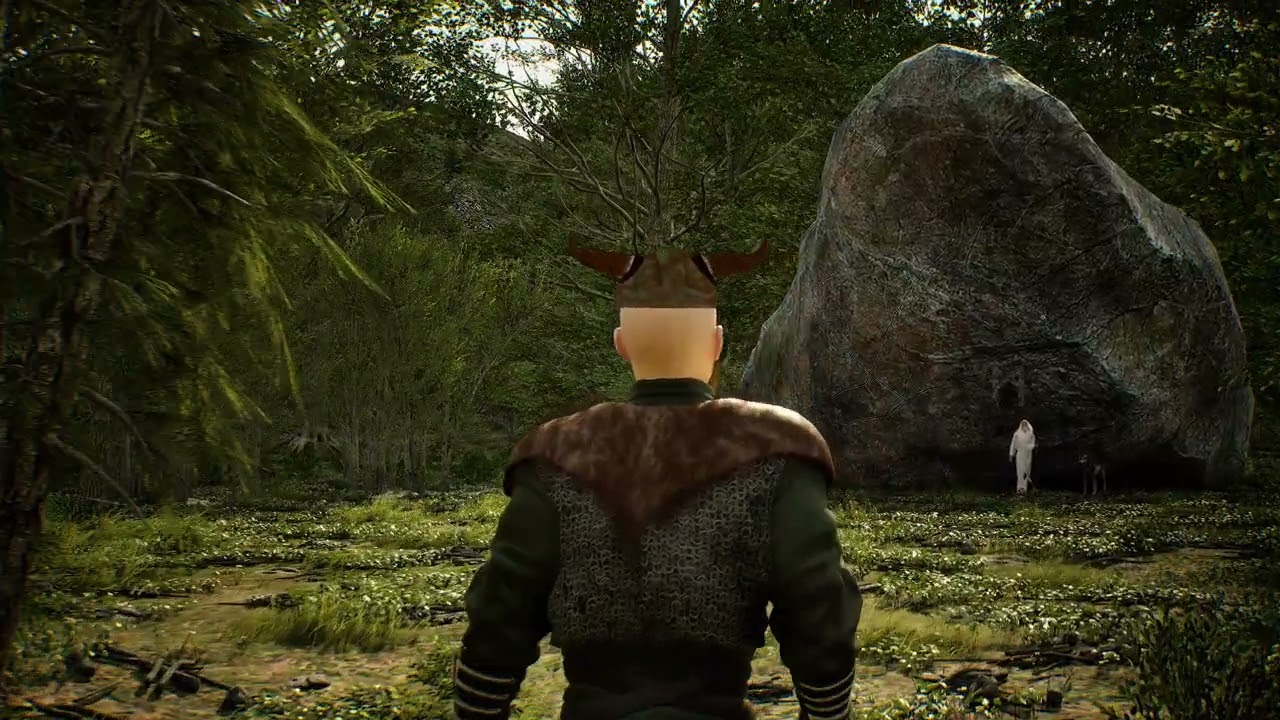
A misty dawn
A silent village
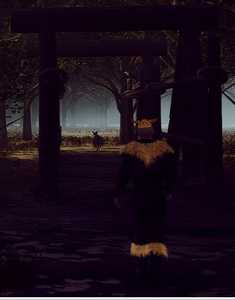
Beyond the bridge
The wolf and the raven wait
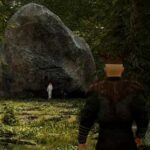
And lead you to the clearing
Before the Standing Stone,
A link between worlds
Stands the Druid
His blessing reveals within you
A new Man
Son of Heaven and Earth
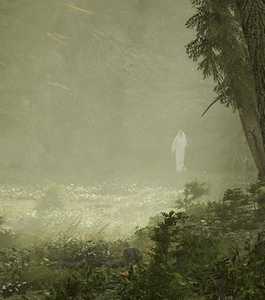
The encounter with our divine aspect, evoked by the standing stone and embodied by the Druid, seals within us the Man who is a synthesis of the Divine and the human—not as a substitute, but as a dynamic offspring of Life, born of the relationship between these two aspects.
Here the conjunction is perfect; the glyph, resembling a couple kissing, mirrors Wunjo twice. While Wunjo heralded a first incarnation of the universal (the wind that stirs the flag) within the singular (the earth that anchors the flagpole), this mirroring expresses a fusion. This is a shared joy resulting from deep harmony, a dynamic harmony that recreates us. The two slants of Ehwaz have been extended: the contact is intimate, sealed. Wunjo’s enthusiasm has become creative fulfillment.

This rune heralds the restoration of the original duality. The competing forces, separated at the beginning by the abyss, find a point of union. Here, Ice takes on its fiery form, and Fire settles within it. There is transparency: our human “form” no longer stands in the way of the divine “force.”
Several encounters with the Divine, our timeless aspect, punctuate the journey of the Futhark, whether it be the messenger—the first emergence of the Inner God in Ansuz—encounters with the Cloud in Raidho and Elhaz, or the unveiling of destiny in Perthro. In Ehwaz, the sy —the synthesis of complementary forces—has taken place and has given rise to a journey. Here lies the consummation in the genesis of the “fulfilled man,” the Inner God.
In the first Aett, following the impulse received from Ansuz, the journey of Raidho produced the Fire of Kenaz; here, the horse born in Ehwaz and the new journey give rise to the conscious Son of Man, aware of the union of Fire and Ice, of Heaven and Earth.

In Sanskrit, Manas means both Man and Mind, which we find in the prefix mens. The Mind referred to here has nothing to do with the content of “our thoughts”: it evokes the inseparable spiritual root of what constitutes humanity, the way the infinite takes form within the finite, the eternal within the ephemeral, Life within our life symbolized by the Druid, the Man in whom Life flows fully.
In Mannaz, there is a relational rebalancing with all our components. Balance with our instinctual, subterranean world—the fruit of the work in Ehwaz—balance with our feminine aspect, our anima, in a joyful and dynamic union, and finally balance with our spiritual aspect in the gradual embodiment of the form of the inner master.
The path we have traveled brings us back here to ourselves, to a deep understanding of the meaning of the contradictions that constitute and animate us. We understand how our personal destiny and our inner gestation intertwine. Here, fidelity to who we are at our deepest core takes precedence. While the Joy of Wunjo closed the first Aett, a revelation of a fullness to come, here that joy has become a dynamic fullness inviting us on a new journey.