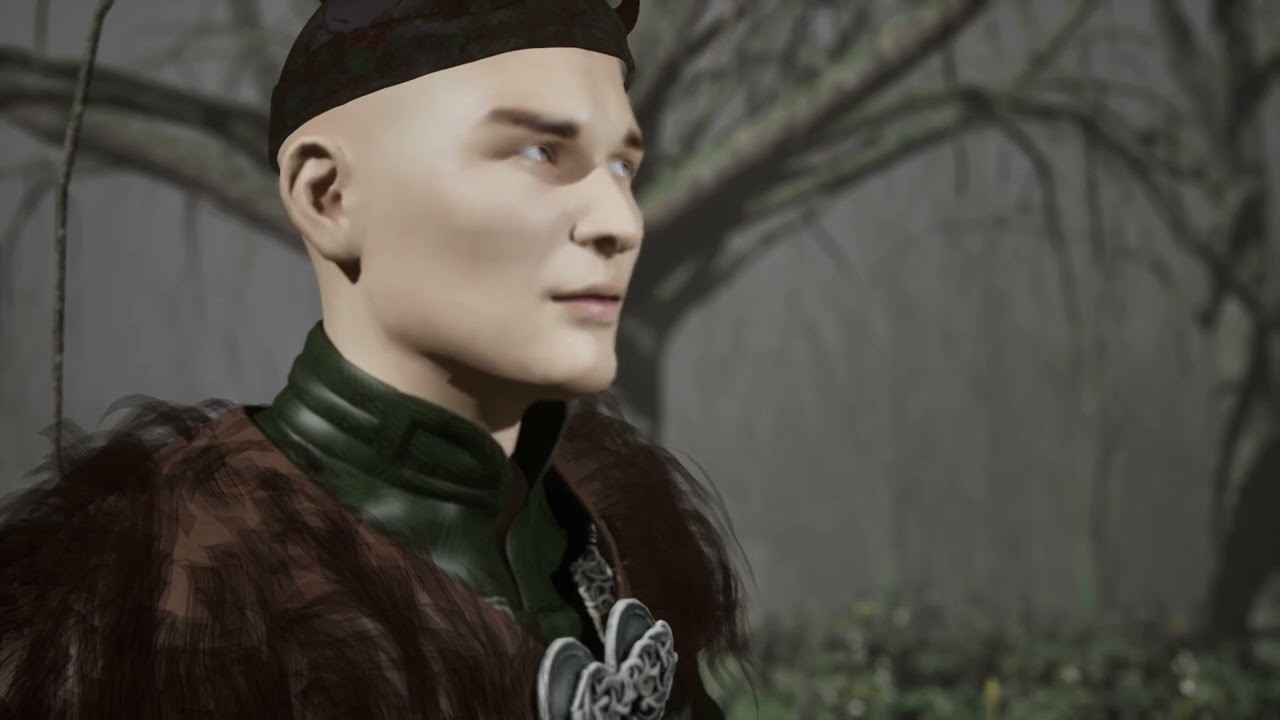
A stone wall
A menacing wolf
A dangerous warrior
You sit, discouraged
The cawing of a raven
Wakes you up
It leads you to the Druid
Who shows you the cave
Penetrating its depths
The rune guides you
Toward the cold, mysterious light.

In Hagalaz, reactive forces have coalesced into hail; in Nauthiz, we are confronted with the forces that give them life—latent forces whose origin lies within us and which trap us in a repetitive cycle.
The appearance of the druid, an emanation of the Inner God, marks a turning point: an inner certainty leads us to draw strength from our depths to find the solution to the obstacles we encounter. The key to liberation lies in this temple of silence, where these forces are powerless. There we discover another path studded with ice, opening onto “the Clear Cold Light.”

While we find here the slash of the previous rune, the two pillars have merged into one: there is radicalization, concentration, and immobilization.
Realizing that we ourselves are the source of what appeared to be external obstacles—which triggered the stormy conditions of the previous rune—we agree to return to the essentials, symbolized by the vertical bar, while allowing the dross to settle via the slash: this is the clear evidence of necessity.
What might have seemed like an external opposition in the previous rune was intended to bring us back to ourselves by eliminating what is incidental or illusory in our lives. The opposition of hail prompts us to understand in this rune that our desires for expansion and freedom must be restrained. The lesson well learned in the previous Hagalaz leads us to discover here that the definitive letting go of what no longer serves a purpose opens doors that were previously closed.

While in the previous rune Fire was imprisoned by Ice—a horizontal force blocking all movement—here there is simplification through concentration. Fire restricts itself, limits itself to avoid being harmed, even darkens itself so as not to lose its essence. Fire is enthusiasm, the desire for transformation, and Ice represents the inopportune aspects of ourselves that are being shed.

The physiological meaning of all suffering is a signal of dysfunction: physical suffering is a symptom of a somatic or energetic disorder; emotional suffering, of an attachment or a weakness of character; mental suffering, of a lack of understanding. In this rune, we understand that breaking the thermometer will not cure the fever: we must now lance the boil.
On our inner journey, there inevitably and inevitably comes a point where our evolution requires us to separate ourselves from the aftermath of the past by confronting what we could not or would not see. From the moment our commitment can no longer be confined to an idealized aspiration, certain aspects of our lives must be restricted or even abandoned; this is the true necessity. We then know that there is no longer any question of procrastinating; we cannot delay, and we must accept restrictions. It is no longer a matter of external or even moral constraints, but rather of inner imperatives: we cannot be content to confront phenomena as in Hagalaz; we must confront their source.
This is not a matter of “heroic asceticism” but of a separation that is now necessary: what was an integral part of our behavior until now is obsolete and must be laid down (this is the meaning of the glyph’s slant) in order to continue the journey. The expression “laying down” is essential—neither flight nor struggle, but necessity and obviousness.
At this stage, discernment is paramount: a forced or ill-timed renunciation will not hold up over time. The restrictions in question are not of a “moral” nature (in obedience to an external law); they respond to the demands of our future. There comes a moment when the path becomes difficult and we must abandon what slows us down or even immobilizes us: we must conserve our strength. This necessity is also the necessity of the right moment: knowing this moment is essential—premature detachment will not dry up the roots, but if it comes too late, the roots will have grown deep and widespread. If we are attuned to what our inner metamorphosis demands, such restrictions become self-evident.
Such detachment will be painful only if the fire of our aspiration has grown cold; obstacles and setbacks are there merely to remind us that the paths our desires lead us down are dead ends—both spiritual and personal—leading us to false freedoms. A deep sense of liberation imperceptibly replaces any notion of loss. We then feel reunited, in harmony with the path that lies before us.
In subtle ways, we may even find ourselves refusing to let go of certain constraints, believing they form the very backbone of our future, whether they be practices or relationships. Listening to our inner voice will then make us understand with certainty that it is time to leave them behind: they have become reactive and hinder our evolution. Once this choice is understood as a necessity, it becomes freedom and simplification, bringing an obvious clarity that foreshadows the next rune.