
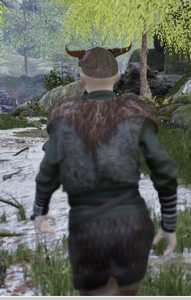
A sudden hailstorm
You move forward without fear
Before you stands the Guardian
You remain motionless
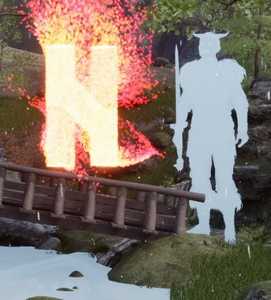
The Rune appears
The Guardian fades away
Hail and ice vanish
The waterfall comes back to life
The Nightingale sings
Like water, you continue on your way
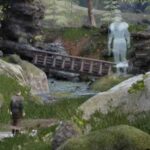
At the beginning of this second cycle, the trials that stand before us are the aggregates of consciousness, the reactive forces that coagulate within the Guardian.
Through the power of Silence, it fades away, and the path of metamorphosis continues.

At first glance, we understand that the road is blocked. The direction illustrated by the point, the sail of Wunjo, encounters an obstacle. The dynamics of the two great pillars of Force are hindered by the slash tending to imprison the energy flows: this is the hail.
At the beginning of this cycle, while the Fehu glyph of the first Aett pointed vertically, arms raised toward the sky, here the slash points downward, showing the path toward the embodiment of Force within form.
The previous Aett ended with an initial conjunction within us of the two fundamental Forces, in which Fire and Ice united in a first dynamic harmony in the joy of Wunjo. At the beginning of the second cycle, the Aett of Hagall, we are confronted with a rupture. Here everything is called into question; the vision of an inner and outer order felt in Wunjo collides with chaos: hail obscures the perceived path.
We must, however, keep in mind that this rupture—the trial following the fullness—is neither a punishment nor a stroke of bad luck. It occurs because, in this second Aett, what was perceived and brought to consciousness in the first Aett must be embodied more deeply, involving everything we are, think we are, and do not realize we are.

The end of the first Aett unfolded under the sign of Fire, the Fire of Kenaz divided into Gebo, the Fire of enthusiasm in Wunjo. Here, the hail, which is the daughter of ice, seeks to imprison this fire within a restriction of the initial momentum encountered in the first cycle.
The first conjunction established in the previous Cycle is obsolete; the balance is imperfect. There is therefore an initial chaos here, reminiscent of the chaos of the origins. But if Fire is captive within the ice, its nature is not lost. It represents the certainty instilled within us during the previous cycle; the ice, the coagulation of inner resistances.
Here lies the ambiguity of the trial, which is at once a pause, a purification, and a challenge. While at first the chaos in which we are plunged may seem incomprehensible, even unjust, there is a part of us deep within that knows it is essential for a new beginning. Fixating on the unfolding of the phenomena assailing us is futile. What must be strengthened here is our capacity for concentration, which emanates from fire—the initial impulse whose presence we felt in Wunjo.
This ice takes the form of the Guardian, the Shadow, the disinherited self—a coagulation of all the reactive forces left behind in the first cycle. And the bridge upon which the Guardian stands is represented by the slash of the glyph, a slender footbridge between two vertiginous peaks. This Guardian is not a foreign and hostile force: if we are not ready, if we have not completed the work of the first Aett, he blocks our path and, in doing so, warns us of the danger of continuing. For in this case, we are not a match for the hail—the aggregates of consciousness unrecognized in the first Aett. Conversely, if this work has been accomplished, the hail dissolves under the action of the Inner Fire, the legacy of Kenaz’s concentration and Wunjo’s enthusiasm.
The hardship mentioned here stems from attachment to obsolete forms. The stronger the attachment, the more difficult the passage will be. The risk is clinging to the structures of the previous cycle, but if all comfort resulting from a persistent settling into Wunjo must be abandoned, we can rely on the depth and quality of what has been experienced, far deeper than our usual feelings.
Whereas the first rune of the previous cycle urged us to set ourselves in motion if we wished to take possession of our inheritance, Hagalaz is merciless toward any form of spiritual satisfaction. Every “noble” intention, every “firm” certainty of the first is swept away by the hail that destroys all superficiality. Here we must abandon what was so dearly acquired, yet we know that remaining where we are would imprison this life in a shell far more deadly than the hail itself. What seems to us a loss of freedom leads us back to our center, to reach the point of fusion where the imprisoned fire will transform the ice of death into the water of life, opening a new path.